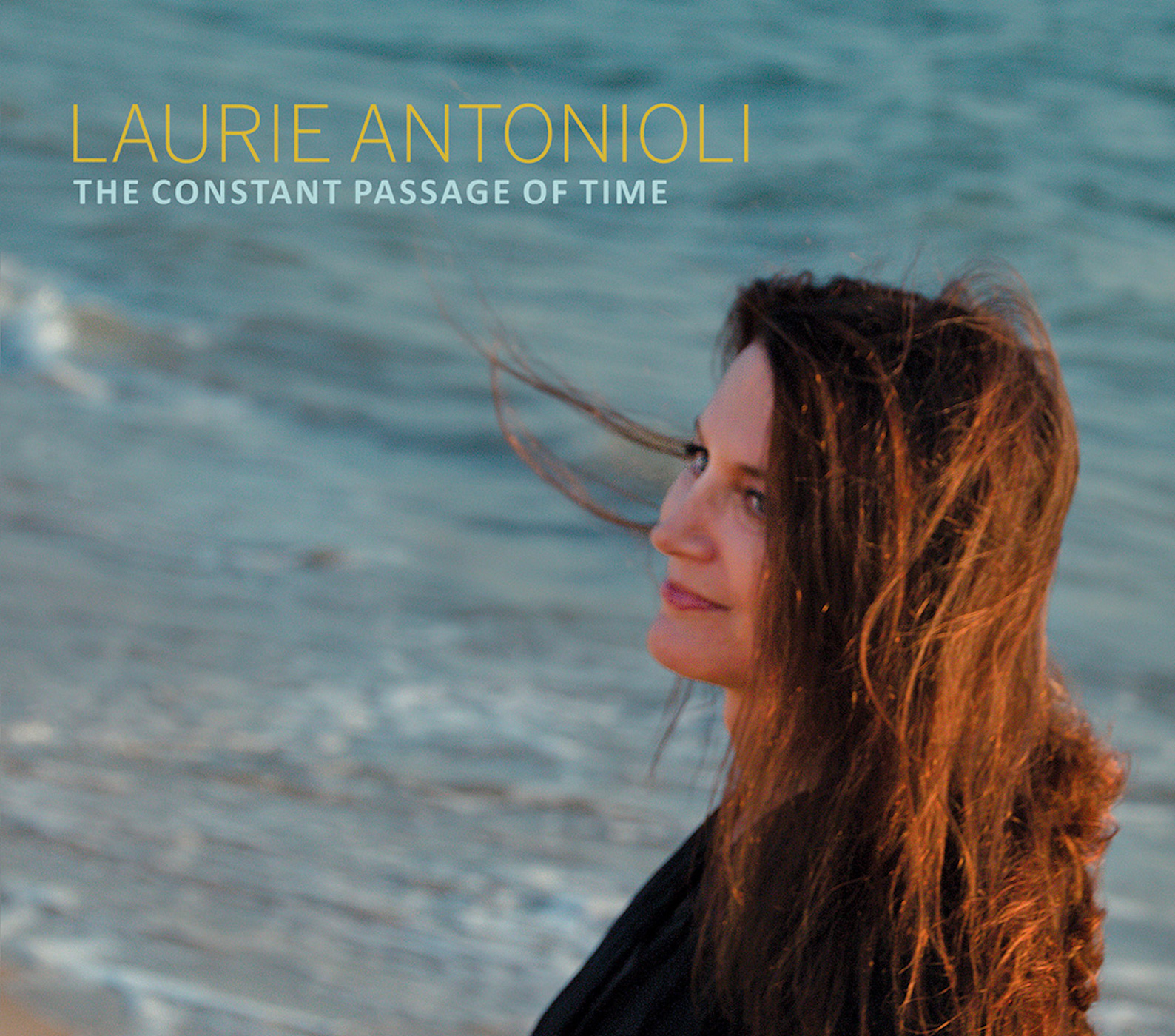
Few topics in jazz spark more passionate disputes than who exactly deserves the title — and not merely the job description — of jazz singer. But there's no debate about Laurie Antonioli, a ferociously creative vocalist who spearheads the Jazzschool Institute's innovative jazz vocal program. Since returning to the Bay Area after teaching for several years in Europe, she's devoted herself to exploring and expanding the possibilities of jazz singing through her work as an educator, bringing her bandstand insights to bear in the classroom.
"What is a jazz singer? I open every class with that question," Antonioli said. "I like Andy Bey's line: It's a feeling. Certainly you should be able to swing and improvise. But there's also a sound, a certain kind of timbre and phrasing, something about how vibrato is used. I spend my life talking about this."
Antonioli offers a jazz master class in how to translate experience into art Thursday, May 26, at Freight & Salvage, where she performs material from her emotionally incisive 2010 album American Dreams. Conceived and mostly developed during Antonioli's tenure in Austria running KUG University's respected jazz vocal program, the album reflects her homesick longing for all of the Bay Area's cultural vibrancy and natural beauty.
"You miss that kind of thing when you're away from it, and the people and the diversity," Antonioli said. "You don't realize that until you go live in a country like Austria where it's mostly one nationality."
Rather than recording a travelogue, Antonioli sought to map her inner landscape on American Dreams. The result is an evocative tapestry woven from the raw materials of jazz, folk, and country music, an approach exemplified by her medley of the cowboy lament "Dreary Black Hills" and "Get Up and Go." She'll be focusing on material from the album at the Freight accompanied by the album's stellar cast, including pianist Matt Clark, bassist John Shifflett, drummer Jason Lewis, reed expert Sheldon Brown, and Mike Abraham, who's taken over the guitar chair from Dave MacNab.
While she's focusing on songs from the album at the Freight, Antonioli developed an expansive book of new material in Austria, often working with the esteemed pianist/composer Fritz Pauer (best known to American jazz fans as trumpet legend Art Farmer's longtime accompanist). She's been slowly breaking in new pieces with the band, crafting arrangements through a "process that's fairly organic," Antonioli said. "I present them with a song and I wait to see what they do with it. We'll nip and tuck it a little bit, allowing arrangements to take shape."
A Bay Area native, Antonioli began writing songs and playing guitar as a teenager in the early- 1970s, inspired by Joni Mitchell, James Taylor, and Neil Young. She discovered jazz through her grandmother's collection of Nellie Luther 78s. Thrilled by the sassy vocals and piano work of the popular 1940s singer, Antonioli started checking out other artists. The search led her to Billie Holiday, who inspired her to start singing standards and to improvise.
She delved into the seminal recordings of Charlie Parker, Dizzy Gillespie, Miles Davis, John Coltrane, and Lee Morgan during a brief stint in Portland, Oregon, studying at Mt. Hood Community College's pioneering jazz vocal program. Back in the Bay Area, she had a chance to put her rapidly maturing scat chops to work when Mark Murphy began inviting her to sit in at his weekly gig at The Dock, a music spot in Tiburon. Witnessing the older singer Nancy King in action provided further education.
"They made me see that you could behave like an instrument and touch people so deeply with a lyric," Antonioli said. "I didn't sing with Nancy at the time, but Mark was very loose and generous on the bandstand, and when he found out I was a singer he invited me up. It was all bebop stuff and that scatting was what led me to Pony Poindexter."
A brilliant, but little remembered musician, deft vocalist, and dedicated entertainer, Poindexter provided Antonioli with invaluable bandstand training and insight into the jazz life. The New Orleans-born saxophonist had cultivated an avid following in Europe, where he had lived for much of the 1960s and '70s. He recruited the 22-year-old Antonioli for an eight-month European tour in 1980.
"Pony taught me in the oral tradition, all these Bird and Diz tunes, scat syllable for scat syllable," Antonioli said.
Antonioli recorded her debut album for Catero Records, 1985's "Soul Eyes," a ravishing duo session with piano great George Cables (the title track features Mal Waldron's lyric for his oft-played standard, which he gave to Antonioli after hearing her sing in Munich). Throughout the decade, she was one of the region's most visible singers, booked at leading venues and festivals with her own band, performing regularly with Bobby McFerrin and sitting in with luminaries like Tete Montoliu, Jon Hendricks, and Cedar Walton at Keystone Korner. She forged particularly close ties with tenor sax titan Joe Henderson, a creative relationship that lasted some two decades until his death in 2001.
"I'm so grateful I got in at the tail end of that scene with all those fantastic cats," Antonioli said. "That's where I learned. Teaching as much as I do, I'm always trying to make sense of things I learned through osmosis, figuring out ways to pass on that information to students."
Things slowed down considerably for Antonioli in the 1990s and she didn't release her second album until 2004's Foreign Affair, a bracing blend of post-bop jazz and Balkan music created with players from Serbia, Albania, Germany, and the United States. A collaboration with bassist and composer Nenad Vasilic, the project resulted from the Eastern European music she heard while living in Austria, which brought to mind music she heard while growing up.
"My grandparents are Yugoslav," Antonioli said. "I heard some Croatian music as a kid. But what drew me in was the Bulgarian Women's Choir, which I got addicted to as a late teen. Those LPs were the soundtrack to my life and I'd always wanted to try to do something using that vocal technique. When I went over to Europe I started hearing these Balkan jazz groups. I hung out with a bunch of Serbs and came up with something that was authentic to me."
Antonioli's work as an educator kept her off the US scene for a significant part of the past decade. At the recommendation of her old mentor Mark Murphy, KUG University hired her as a professor for the vocal jazz department in 2002. In the summer of 2006, Susan Muscarella coaxed her back to the Bay Area to work at the Jazzschool. Under Antonioli's leadership the jazz vocal program has attracted a glittering array of guest artists to conduct workshops, including Janis Siegel, Judy Niemack, and Roseanna Vitro. Gretchen Parlato and Theo Bleckmann are scheduled to work with students later this year. But the program's most significant innovation is providing superlative accompanists for the students, either Antonioli's rhythm section with Matt Clark, John Shifflett, and Jason Lewis, or Clark, bassist John Wiitala, and drum maestro Eddie Marshall.
"That's worth the price of admission right there," Antonioli said, adding that she's not just schooling students in the American Songbook — she's also churning out some real singers.
Laurie Antonioli: Press
Singer Antonioli is a
rare talent, too rarely seen
beyond the Bay area.
While vocalist Laurie Antonioli may not be a household name, she is not exactly an unknown quantity. The Bay area native has been singing pre-professionally and professionally since the late 1970s, initially influenced by the diamond songwriting talents of Joni Mitchell, James Taylor and Neil Young. She took a right turn listening to her grandmother's 78s of the bawdy and bold jazz/blues princess Nellie Lutcher, which led to the universes of Billie Holiday and Ella Fitzgerald.
Formal study, careful examination of Nancy King, and an invitation by Mark Murphy brought Antonioli and her developing scat chops to public attention. During this period, she concentrated largely on bebop, drawing her into orbit with excellent but largely unheralded saxophonist/vocalist Pony Poindexter. Poindexter took Antonioli on the road for a European tour that ended as an eight-month pilgrimage.
In 1985, Antonioli debuted on vinyl with Soul Eyes (Catero Records), recorded with pianist George Cables. In the years following, the singer became a staple of the Bay area, working with singers Bobby McFerrin and Jon Hendricks, pianist Cedar Walton, and most closely with the late saxophonist Joe Henderson, a relationship lasting until his death in 2001.
Antonioli has spent the lion's share of the years since 1985 working as a music educator in the US and abroad. In 2002, Mark Murphy suggested Antonioli for a professorship in the jazz vocals department at KUG University in Graz Austria, where she worked until the summer of 2006, when she returned to Northern California to teach at the Jazz School in Berkeley.
Surrounding her repatriation, Antonioli returned to the recording studio, recording two new collections, the second being American Dreams (Intrinsic Music, 2010). Once lost to the academy, Laurie Antonioli has returned in a big way, emerging as a powerful constellation in the west. Here is what she has been up to in the studio under her own name.
Laurie Antonioli and George Cables
Soul Eyes
Intrinsic Music
2010 (1985)What the duet Soul Eyes reveals in Antonioli is a talent evolving with impressive velocity. As a debut recording goes, the singer emerges fully formed with chops to burn. Antonioli and pianist George Cables ride a minimalist ”In A Mellowtone” out of the chute, Cables playing with Count Basie-like attention to notes, sprinkling only those necessary to support Antonioli's fresh-scrubbed youthful voice. Her scat shops are perfectly intact, melding naturally with Cables' piquant comping. “Prelude to a Kiss” is humid Duke Ellington, Antonioli, relaxed, dancing with Cables in a full-bodied performance, the pianist more orchestral.
The ballad “Lazy Afternoon” displays the paradox of Antonioli's youthful maturity. By the time of these recordings, the singer had already sung with Mark Murphy and toured with Pony Poindexter. That wealth of bandstand experience provided Antonioli abilities beyond her years. This manifested as a fresh approach to established standards that could not be achieved by older artist. Juxtaposed against the exacting scat of Charlie Parker's 1948 composition “Barbados,” a view of Antonioli's range is readily secured.
Antonioli covers two tunes composed by uber-composer Larry Gelb: the angular ”Bird Lives” and the inventive “I'd Like to Melt Your Ego for Dinner.” On these difficult tunes, she excels in navigating the songs' melodic corners and recesses with Gelb's too clever lyrics. Antonioli revealed that a full album of Gelb songs was once recorded and never released. From these samples, release of this material would certainly be welcome. Soul Eyes was a bright and assertive debut by an artist intent on further growth and evolution.
Laurie Antonioli featuring Nenad Vasilic
Foreign Affair
Nabel Music
2004Twenty years later, Laurie Antonioli's musical vision was fully expanded. Where Soul Eyes showcased a keen jazz sensibility, Foreign Affair shows Antonioli picking up where Cassandra Wilson left off with recordings like Blue Light 'Til Dawn (Blue Note, 1992) and New Moon Daughter (Blue Note, 1995). Wilson opened the jazz doors to a more organically conceived presentation, recasting the expected (”You Don't Know What Love Is”) and unexpected (”Death Letter”). Where Wilson plied her wares with increasingly larger groups with increasingly esoteric instruments, Antonioli keeps things small, acoustic and very fundamental.
The majority of Foreign Affair is original material by Antonioli and bassist Nenad Vasilic, a titanic talent himself. The neighborhood of the music is distinctly Eastern Europe, brandished by the presence of Vasilic and the rich Old World heritage of Antonioli herself. Heritage informs every song on this disc. The opener is a Vasilic original, “Ballad for Djole,” a languid tango that readily illustrates the value of drummer John Hollenbeck to jazz and music in general, and also exactly how breathy a tenor saxophone played by Johannes Enders can be. Sensual, sexual, slowly ebbing, this piece perfectly frames what can be expected from the rest of the disc.
”Holy Water,” written by bassist John Shifflett and Antonioli, is a crisply beautiful tome on spirituality, sporting Vasilic's exacting bass and Ender's soprano saxophone. “Where Flamingos Fly” returns to the languid voluptuousness of the opening number, propelled by Vasilic's demanding bass figure and guitarist Armen Xhaferi's modern accompaniment. Likewise is Vasilic's “Tschusch Chochek.” Hollenbeck's precise and understated drumming balances Antonioli's Eastern thinking vocalese, achieving an unusually fine musical eutection. Antonioli's “I Know You” might be the jazziest of the pieces, but then again, it is more broadly based. Joe Henderson's “Crni Narcis” and Keith Jarrett's “The Cure” reveal the singer's acute interpretive power. The latter presents more Antonioli vocalese/scat talent, presented to very great effect.
Laurie Antonioli and Richie Beirach
The Duo Session
Nabel Music
2005While chronologically next in the Antonioli discography, The Duo Session was recorded between the two former releases in 1992. Another piano-voice duet, this time with pianist/composer Richie Beirach, The Duo Session takes on the quasi-theme of vocalese based on trumpeter Miles Davis' Kind of Blue (Columbia, 1959). Chief among the Blue offerings are highly impressionistic performances of “Flamenco Sketches” and “Blue in Green.” Beirach is a much different pianist and accompanist than George Cables, drawing out a greater maturity in the singer.
”You and the Night and the Music” and “On Green Dolphin Street” are the straightest jazz on the disc, but are not without their surprises. In the former, Beirach provides percussive instrumental drama to sweep Antonioli's sensual tsunami to its only logical conclusion. The latter standard is revealed as a straight-man lament to the movie-by-the-same-name's spoof plot. “You Don't Know What Love Is” is given a driving edge with lightly dissonant piano by Beirach. Antonioli sings from her lower register, muscular, assertive and commanding.
Larry Gelb's “New Souls” adds a quiet grace to the recording. A ballad in name and personality, the song could easily be a Broadway aria. The closing two Beirach compositions find Antonioli entering the Theo Bleckmann realm of vocal performance art, where she modulates her voice in what can be considered extra-jazz ways. That may be the most appropriate way to hear her music, as expanding the creative edges of not just jazz, but all music.
Laurie Antonioli
American Dreams
Intrinsic Music
2010American Dreams brings us to the contemporary Laurie Antonioli. The disc is a collection of originals, standards and ringers that together act as the most logical evolution out of Foreign Affair. The singer's vision extends into the realm of Americana in a fresh and informative way, further extrapolating the language of Cassandra Wilson from the 1990s. Again, Antonioli relies on a superb bassist in John Shifflett and drummer Jason Lewis, who provide the perspicacious rhythm drive that makes this recording such a brainy one. Antonioli achieves a natural balance between the emotive and intellect in both her choice of repertoire and its performance.
The singer teams up with KUG colleague and pianist Fritz Pauer for close to half of the offered selections, the best being “How Long” with its distinctly Midwestern flavor courtesy of Dave McNab's sinewy slide guitar. The melody and structure, as well as Sheldon Brown's tenor saxophone, recall a young Billy Joel, circa The Stranger (Columbia, 1977), brilliantly updated. The singer digs deeper into the American landscape with “The Dreary Black Hills/Get Up and Go,” again buoyed by guitarist McNab, whose solo on “Get Up and Go” echoes Toy Caldwell with a serious jazz jones. “America the Beautiful” is sumptuous with Antonioli's rich voice and Sheldon Brown's spot-perfect bass clarinet brushing with broad strokes. This is a beautiful American landscape captured in music.
Antonioli's treatment of the standards “Moonlight in Vermont” and “Oh, What a Beautiful Morning” are startlingly framed by the singer's exceptional band. Pianist Matt Clark provides a unique ivory presence that holds together these aurally vaporous apparitions, while Brown's tenor follows the singer's voice like two sparrows chasing one another. As a lyricist, Antonioli joins a rarefied group that includes Hendricks, Eddie Jefferson and Oscar Brown, Jr. as evidenced by her Fritz Pauer collaborations and her sole song composed with Richie Beirach, “Long Way From Home.” It is not hyperbole to say that Laurie Antonioli is emerging as the most important vocalist, let alone jazz vocalist, this decade. Let us hope for much more music from this brilliant constellation in the west.
The remarkable ingenuity of Laurie Antonioli's voice is owed, not just to the impossible range--some three octaves--but to vocalist's breathtaking ability to find the hidden quarter tones that sound between the so-called right ones. In suggesting that these notes she sings are “wrong,” the idea of a Thelonious Monk-like reality emerges in Antonioli's singing. The elemental difference is one of rhythm: while Monk's was chopped and jagged, sly and askance, Antonioli's is smooth, with burgeoning glissandos that are forthright, yet unexpected; that follow a distinct melodic line, yet make surprising harmonic leaps. And while Antonioli may be a singer whose vocalizing takes magical routes through the diatonic scale, she is capable--and proves time and time again--that she owns the diatonic scale as well. Antonioli enjoys loping across the expanse of the regular Western harmonic scale, but can, on a dime, turn her voice into that of a Hindustani vocalist negotiating a complex Indian raga.
American Dreams is filled with wonderful, chromatically ingenious examples of Antonioli's vocal brilliance, with the singer melting the artificial barriers set up to separate rather than unite music. She is an old soul who, restless at all times, meanders like a medieval apothecary in search of the magic potion--in this case, the song with the most perfect tone and manner, or a tune of such breathtaking lyricism that it stops the very breath itself. In this regard, Antonioli constantly recalls the lyricism of the great Sufi masters, whose singing turned meditative and who became so entranced by the nature of their spiritualism that the art came to reside on a uniquely different plane. There are times when Antonioli gives the impression that she reaches a similar meditative state.
”Samba Nada Brahma” is just one of those songs, where Antonioli makes a Sufi-like leap with the elasticity of her vocals. The fact that she weaves the lyric in and out of a startling melody written by pianist Fritz Pauer--one of four songs they wrote together--is one of the bright spots on this album. The team of Pauer and Antonioli is a remarkable one: both musicians explore melody in great depth, and Antonioli, with masterful use of harmony, surpasses most vocalists in lyricism and depth of character. With a first rate band that includes multireedman Sheldon Brown and a bright young guitarist, Dave McNab, the ensemble provides plenty of room for Antonioli to undertake her extraordinary vocal journeys. “Vienna Blues” appears alongside the standard “Moonlight in Vermont,” and it is impossible to tell that the two have been written with years between them, so breathtakingly beautiful is the classic lyricism of the former. And, in her superb version of “America The Beautiful,” Antonioli undertakes a rite of passage for a vocalist, emerging almost heroic by the end of it all. As a vocalist, Antonioli displays the spark that always flies when Joni Mitchell takes to song.
Calling American Dreams a jazz album is too narrowing a description. This record is actually an odyssey through the American musical landscape. After recording Foreign Affair (Nabel, 2004), with a multi-cultural cast of musicians while living abroad, vocalist Laurie Antonioli's mind drifted back toward thoughts of home. In exploring her vision of America, Antonioli touches on standards, country, folk and patriotic music. These entries are nestled within a collection that also includes a good amount of material resulting from a marriage of her lyrics with the music of pianist Fritz Pauer--the longtime accompanist for trumpeter Art Farmer.
In lesser hands, these disparate musical ideals might have resulted in an album that suffered from multiple personality disorder, but Antonioli and her exquisite band help fuse all of these songs into a unified musical expression. While a song called “Samba Nada Brahma” might seem like an odd way to start off an album that speaks of America, it provides instant excitement as Sheldon Brown's soprano saxophone work bounces around with boundless energy. “Moonlight In Vermont” gives Antonioli a chance to showcase her superb scatting skills and bassist John Shifflett provides excellent support here. “How Long,” one of five pieces credited to Pauer and Antonioli, has an alt-country vibe and--if one looks past the saxophone solo--it sounds like it could have come from the Emmylou Harris songbook. Brown--one of the key ingredients on this record--provides some harmonica work at the top of “Dreary Black Hills” and Antonioli's voice picks up a bit of country twang on this traditional tune. This song transitions into “Get Up And Go”--an earthy, appealing original from Shifflett--and Antonioli's voice takes on a firmer, focused quality here.
In addition to bringing stylistic authenticity into every song on the album, guitarist Dave McNab put together a gorgeous arrangement of “America The Beautiful.” Antonioli slowly lays out the visually rich lyrics over a warm bed of guitar and Brown's bass clarinet work adds volumes to the performance. Freer forms of expression come through on the loose and woozy “Stimulus Plan,” as Jason Lewis' jittery cymbal work scurries around and Antonioli moves in tandem with Brown's bass clarinet. Broadway also makes a brief appearance and “Oh, What A Beautiful Morning” is taken at a relaxed pace, with pianist Matt Clark providing the harmonic foundation for Antonioli and Brown--on tenor saxophone here. From start to finish, American Dreams proves to be a happy marriage of cultural appreciation and musical creation.
Track Listing: Samba Nada Brahma; Vienna Blues; Moonlight In Vermont; How Long; Sweet Sound Of Spring; Under Consideration; Stimulus Plan; America The Beautiful; Dreary Black Hills/Get Up And Go; Just A Dream; Oh, What A Beautiful Morning; Long Way From Home.
Personnel: Laurie Antonioli: vocals; Matt Clark: piano; John Shifflet: bass; Jason Lewis: drums; Sheldon Brown: soprano saxophone, tenor saxophone, bass clarinet and harmonica; Dave McNab: acoustic and electric guitars.
It’s ironic, really, that one of America’s foremost jazz vocal instructors is comparatively little known as a jazz vocalist. It’s equally ironic that so exceptional a jazz teacher garnered her training less from formal classes than from studying three masters: Nancy King, Mark Murphy and Pony Poindexter. Her work as an educator began in 2002 at KUG University in Graz, Austria, and it was there she began collaborating with pianist and composer Fritz Pauer.
Five of their joint efforts form the backbone of this cunning reverse travelogue, which examines the tremendous pull of home and its familiar comforts one feels from distant shores. American Dreams opens with two ostensibly Austria-centric collaborations: the sizzling, propulsive “Samba Nada Brahma,” shaped of the homesickness for the Marin countryside Antonioli felt upon discovering the Vienna woods, and the dreamily melancholy “Vienna Blues,” which speaks to the hopeless desire of finding an ideal locale to rekindle a fading romance. Their “How Long” paints a stirringly plaintive portrait of a woman’s wait for her lover’s return, while “Sweet Sound of Spring,” with its folk underpinnings, examines the intense—if too often overlooked—beauty of the familiar.
Antonioli returns to domestic musical soil for an arresting, angular “Moonlight in Vermont,” a languid “Oh, What a Beautiful Morning” wide as the Oklahoma sky, and a delightfully twangy “Dreary Black Hills” that opens up to reveal the glorious expansiveness of her own “Get Up and Go.” But it is her gently soaring, blues-lined “America the Beautiful,” arranged by guitarist Dave McNab, that truly brings the album home.
Vocal CD of the Month
Laurie Antonioli: "American Dreams" (Intrinsic Music) 2010
Highly challenging approach & adventurous singing & creative phrasing throughout the album, one of the best vocal jazz releases of the year.
Highlights: "Just a Dream," "Samba Nada Brahma" and "Vienna Blues," three songs co-penned with Austrian piano master Fritz Pauer (Art Farmer, Kristin Korb); the Ornette Coleman-ish "Stimulus Plan," written by Paul Nagel, once again with Antonioli providing the sharp lyrics; and notable renditions of the standards "Moonlight in Vermont" and "Oh, What a Beautiful Morning" that would make Carmen McRae proud.
The interactive band -- Matt Clark (pianos), John Shifflett (bass), Jason Lewis (drums), Sheldon Brown (soprano & tenor saxes, bass clarinet, harmonica) and Dave McNab (guitars) -- sounds impeccable, with reedman Brown shining specially on bass clarinet, but also contributing a truly perfect tenor solo on "Oh, What a Beautiful Morning." My dear friend Mark Murphy always praised about Laurie. Now I know why.
Fono Forum Germany November 2004 CD of the Month FOREIGN AFFAIR.
FROM SAN FRANCISCO TO GRAZ This debut is actually a comeback and a most welcome one at that. It began with American singer Laurie Antonioli's move from the San Francisco Bay Area to Graz, where she recently entered on a professorship in vocal jazz as successor of no less prominent vocalists than Mark Murphy, Sheila Jordan, Andy Bey and Jay Clayton. But Laurie Antonioli is no blank page, either. She can count Mark Murphy, Bobby McFerrin and Joe Henderson among her mentors, with the pianists George Cables and Joe Bonner she made her first records almost twenty years ago. Then she withdrew from the music scene for personal reasons and redirected her energies to teaching. Which is what brought her to Graz, a stone's throw from former Yugoslavia, where her father's family came from. Yugoslav-Balkan music and the Serbo-Croat language were part of the soundtrack of her early childhood in California; she came to know and love jazz through her grandma's Louis Armstrong records. While at high school and college she expanded her musical horizons towards modern jazz, singer/songwriting, folk and world music.
In Graz she had the a chance to bring all these strands together. It's there she met the Serb bassist Nenad Vasilic, who already brought out a very fine Balkan Jazz album in 2003 ("Joe Jack", Nabel 4693), and made him the mainstay of her own band. Three pieces on the new album are from his pen, among them the melancholy, tango-like opener "Ballad for Djole", for which Laurie Antonioli wrote original lyrics. The band is completed by the Albanian guitarist Armend Xhaferi, the New York percussionist John Hollenbeck and the Munich saxophonist Johannes Enders, who has long since established himself as one of the most versatile jazz musicians on the German scene. Here he reveals one more facet of his talent, fitting right into the project and genre on hand. So, this is an international line-up with a definite Balkan emphasis. The recordings were made in an analog studio in Slovenia; for the mix, Laurie Antonioli succeeded in getting the American engineer Jay Newland, who won a Grammy for his work with Norah Jones. The effort paid off: the album breathes warm, purely acoustic sound and an intimate atmosphere. This setting shows off the dark, sensuous timbre of the leader's voice to best advantage. Laurie Antonioli chose the songs to fit a theme of separation by borders, oceans and distances and the longing for such barriers to be dissolved. Musically the singer straddles the boundaries between styles and cultures, folk and jazz traditions, Eastern Europe and America. She takes from the jazz repertoire of Joe Henderson, providing his "Black Narcissus" with a Serbo-Croat title (Crni Narcis) and Keith Jarrett, scatting to the pure groove of his "The Cure". She combines the folk-song-like "Where Flamingos Fly" to the Traditional "Black is the Color" to make an American folk-jazz medley. Not many artists can combine all these elements as organically and originally as Antonioli, who in two of the pieces also documents her talent as a composer. Anyone who would like to experience the singer live has the opportunity to do so at the Unterfahrt in Munich on 30 October and in Birdland in Vienna on 7 November. MUSIC ***** SOUND *****
Jazz Podium January 2005 - Foreign Affair
Between the tradition of the Great American Songbook and the better class of pop song there's no shortage of women singers - some acclaimed as new divas while others, measured against Ella & co, are found wanting. But only a few women are carving out new paths of a contemporary vocal jazz. Laurie Antonioli is a Californian with Montenegrin ancestors, now a university teacher in Graz, who is able to weave classic jazz singing, modern instrumental-sounding vocalizations and elements of Balkan folk into a valid vocal language of her own. Her influences are not only such diverse singers as Louis Armstrong, Joni Mitchell, Neil Young, Bobby McFerrin und Mark Murphy, but also include instrumentalists like Miles Davis, Wayne Shorter, Keith Jarrett und Joe Henderson. She made her debut on albums of pianists George Cables ("Soul Eyes", 1985) and Joe Bonner ("New Beginnings", 1987), and after that, family and teaching interests took priority. With the dark timbre of her voice she can converge with the bass sound of Nenad Vasilic or equally, in higher registers with the fine, sweetly sculpted lines that Johannes Enders produces on the soprano sax. The whole recording lives in the matured sound of an uncluttered instrumental lineup. Antonioli carefully selected the collaborators for her distinctive project: Johannes Enders, individualist on saxophones, Nenad Vasilic, tersely phrasing Serbian bassist and co-composer, Armend Xhaferi, Albanian guitarist who works with bending techniques from blues and country, and John Hollenbeck, the stylistically adaptable percussionist from New York. Highlights are the tracks where Antonioli enjoys extended scats, oriental-mystical and deftly rhythmic on Vasilic's "Tschusch Chochek", bluesy on Antonioli's own "I know you" and entranced-swinging on Keith Jarrett's "The Cure".
LAURIE ANTONIOLI AND RICHIE BEIRACH- THE DUO SESSION
JAZZZEIT MAGAZINE DECEMBER 2005 5 Stars
You could think of the well-aged duo recording of Laurie Antonioli and Richie Beirach an exquisite bottle of wine (vintage 1992) which sets free the essences of standards and originals from Miles Davis, Ivan Lins and Richie Beirach himself ("Nightlake", "Elm"). Laurie Antonioli is well-known for composing her own lyrics, with which she goes beyond simply the musical level, offering the listeners another association to the music. Her alto voice, connected to Beirach's lyrical playing, creates timeless music, conjuring up the intimacy of a private conversation in the studio. The past and the present hand in hand, Antonioli's lyrics mirror, and introduce new ideas to, Miles Davis' "Flamenco Sketches" and "Blue in Green". Beirach follows her thoughts in a melodically structured way, accompanies and allows them to shine like musical diamonds
ALL ABOUT JAZZ Jim Santella
The Duo Session
Recorded in 1992 in San Francisco, this session of piano/vocal duets features a silky-smooth singer in performance with an expressive pianist. Their warm, endearing approach brings you into their circle with open arms and a heartfelt embrace. Together, the two artists interpret moody standards, hip reflections, and searing originals with candor. Laurie Antonioli's clear alto voice and extensive vocal range allow her to express ideas and emotions freely and accurately. What she's thinking is what comes out naturally. Partnering with Beirach, she's confident and convincing. Richie Beirach's consonant harmonies and lush undercurrents provide a kind of acoustic depth that fills the room. His shadows cast far and wide. Each piece finds the pianist as musical partner to the vocalist, sharing in the experience with a lot to say. They give "Green Dolphin Street" a moody texture and "Flamenco Sketches" a dreamy whirl. Miles Davis had passed away the year before this date, and he was surely looking down from above with a smile. The session runs solemn and moody, befitting the legacy that the trumpeter left behind. Beirach and Antonioli collaborated on several original numbers, pouring the same heartfelt emotion into each one. They prefer slower pieces that allow ample room for patient expression. Their "Memories, Dreams & Reflections" summarizes the performance through its creative infusion and unique duet interaction. Today, Antonioli is head of the Vocal Jazz Department at KUG University in Graz, Austria and Beirach is head of the Jazz Piano Department at Felix Mendelssohn-Bartholdy in Leipzig, Germany. They're working together again in live performance. It's time they recorded a few more duo albums to let a worldwide audience enjoy the spirit of their work. Surely any followup to this highly recommended album would feature the same wholesome music.
"Laurie is truly one of my favorite singers; she's full of wonderful ideas, has an instinctive musicality, a great sense of humor and is an inspiring improviser and collaborator." Bobby McFerrin
"Laurie is the most talented singer I've ever had the pleasure of working with. She is a very important creative voice in jazz music. As a singer of improvised music and jazz, she is a piano players dream. The world is filled with good jazz singers. There’s only really a handful of exceptional, iconic voices among them: Billie Holiday, Ella Fitzgerald, Sarah Vaughan, Betty Carter, Cassandra Wilson. These are the real jazz singers of ours and past generations. I would effortlessly add Laurie’s name to that list.” Richie Beirach
"When a girl of 17 or 18 wakes up in the morning and can start right off with a horn-like bebop solo, I know the bop angel has been at work again -- that was Laurie Antonioli and she's still doing it." Mark Murphy
"Laurie is one of my all time favorite lyricists. Her singing is exquisite - she lives in her beautiful low tones - her sound is completely unique." Nancy King
"Laurie's distinctive voice, unique artistic perspective, emotional depth and burnin' improvisational skills assure her a place as one of the very best jazz singers alive today. A major talent." Kitty Margolis
"Laurie is the embodiment of the true spirit of jazz - probing, penetrating, burning with the white-hot intensity of a Plugged Nickel Miles Davis. She blows my mind. Laurie is hard-core." Ann Dyer
"In a world increasingly populated by singers who are jazz-flavored stylists at best, Laurie Antonioli stands out as the REAL deal. She's a true jazz explorer who's not afraid to take risks as she reaches deep into the improvisational essence of the music." Bud Spangler, Jazz Radio Host, San Francisco, California
The word is out on the musicians’ grapevine. When it comes to vocals, the Jazzschool has become an invaluable forum for transmitting the tradition and presenting many of the most creative singers on the scene.
This weekend’s programming makes the case, with two rising stars from New York City offering concerts and workshops. Sachal Vasandani, a Chicago native who has quickly established himself as one of the most confident young male singers finding inspiration in jazz, performs Friday night and presents a vocal skills master class on Saturday afternoon.
With three releases on Mack Avenue since 2007, Vasandani has displayed a sharp ear for interesting material, a warm, deep-grained tone, and supple, relaxed phrasing at even the briskest tempos. He’s joined Friday by prodigious saxophonist Dayna Stephens, a Berkeley High grad who’s become a major force in New York City despite dealing with a life threatening medical condition.
Saturday marks the Northern California debut of singer/songwriter and guitarist Becca Stevens playing her own material (followed by a master class Sunday afternoon). She’s probably best known in the Bay Area as a member of pianist Menlo Park-raised pianist Taylor Eigsti’s band, though she’s also performed in San Francisco with Bjorkestra, the New York big band devoted to the music of Icelandic pop enchantress Björk.
Stevens first got involved with the Jazzschool last summer when she gave a well-attended workshop. In the area for a stint on faculty at the Stanford Jazz Workshop, she came away from Berkeley ready to spread the word about the Jazzschool’s vocal program.
“I was really blown away with the spectrum of people who came in to take the class,” she says. “I had people who weren’t musicians at all, but still participated in the exercises that we did, which was really cool. I had people who were musicians, a Broadway singer, and on the other side of the room, someone strictly R&B. By the end of the class I had them all singing parts of my songs. I remember thinking that three hours seemed daunting. I had this really elaborate lesson plan written out, and it just flew by. I could have easily filled nine hours.”
In her mid-20s, Stevens is a new-school jazz singer who draws deeply from folk and indie rock. That said, her jazz colleagues haven’t paused in embracing her. Peers like Kate McGarry and Kurt Elling have hailed her as one of the most original young vocalists on the scene, while heavyweight players like pianist Brad Mehldau, trumpeter Jeremy Pelt and SFJAZZ Collective drummer Eric Harland have recruited her for projects and recordings. Whatever context she’s working in, Stevens makes a vivid and enduring first impression.
Goose bump reaction
“The first time I saw Becca perform I was completely in awe of her voice and intensity, the level of emotion and intellect,” says vocalist Gretchen Parlato, who collaborates with Stevens in Tillery, a three-woman vocal project with Rebecca Martin. “She’s a ridiculous singer and songwriter, and whether it’s in a rehearsal or performance I have jaw-dropping, goose bump reaction every time I hear her.”
The 2011 release of her second album “Weightless” (Sunnyside) has provided a similarly revelatory calling card for Stevens. While there’s an unmistakable Bjorkian current running through some of her serpentine melodic lines, she claims folk, alt-pop, postbop and European classical music as a birthright.
Raised in Winston-Salem, she grew up in a family suffused with music, and started performing with the family band, the Tune Mammals, at the age of two. Led by her father, William Stevens, a composer specializing in sacred choral music, the Tune Mammals performed his playfully folky original songs for children. Her mother, Carolyn Dorff, is an operatically trained singer who has worked extensively in musical theater. At 10, Stevens starred with her in a yearlong Broadway touring production of “The Secret Garden.”
“Music and art is something that’s very natural for me,” Stevens says. “My father would write with us in the room. I must have been five or six and I remember him writing the song I was going to sing solo on the second record, ‘Too Cute to Spank,’ the title track.”
She studied classical guitar at North Carolina School of the Arts during the day, while singing standards at clubs around the region at night until she matriculated to the New School. Where singing jazz provided an edgy identity for her in high school, “going to jazz school takes all the rebelliousness out of it,” she notes. These days, Stevens is making up her own rules.
![]()
Laurie Antonioli, vocalist and director of the Berkeley Jazzschool’s vocal program
For Laurie Antonioli, the veteran vocalist and director of the Jazzschool’s vocal program, that’s what makes Stevens such an important new artist. She’s built the program by drawing on the Bay Area’s deep bench of vocal talent for the faculty, while attracting the most adventurous singers from points east for concerts and workshops. This season’s lineup includes Peter Eldridge on May 13, and a weeklong residency by Theo Bleckmann (Aug. 13-19), a singular stylist who recently released an album interpreting the music of Kate Bush.
The Jazzschool also offers a monthly jam session for vocalists, an effort to cultivate an environment where singers can learn from musicians and each other on the bandstand.
“It’s very much a part of my master plan for the program, to try to create a community of musicians outside of the club,” Antonioli says. “The way I learned was simply by listening and experiencing many people in a live setting. Back in the day when Bobby McFerrin and I lived in Noe Valley, we’d practice scat singing with Jamie Aebersold records. I’m afraid if we don’t try to make this happen in academic environments we might lose that spirit.”
A Bay Area native, Antonioli began writing songs and playing guitar as a teenager in the early 1970s, inspired by Joni Mitchell, James Taylor, and Neil Young. She discovered jazz through her grandmother’s collection of Nellie Luther 78s. Thrilled by the sassy vocals and piano work of the popular 1940s singer, Antonioli started checking out other artists. The search led her to Billie Holiday, who inspired her to start singing standards and improvising.
She delved into the seminal recordings of Charlie Parker, Dizzy Gillespie, Miles Davis, John Coltrane and Lee Morgan during a brief stint in Portland, studying at Mt. Hood Community College’s pioneering jazz vocal program. Back in the Bay Area, she had a chance to put her rapidly maturing scat chops to work when Mark Murphy began inviting her to sit in at his weekly gig at The Dock, a music spot in Tiburon. Witnessing Nancy King in action provided further education.
Touching people with a lyric
“They made me see that you could behave like an instrument and touch people so deeply with a lyric,” Antonioli says. “I didn’t sing with Nancy at the time, but Mark was very loose and generous on the bandstand, and when he found out I was a singer he invited me up.”
Antonioli recorded her debut album for Catero Records, 1985’s “Soul Eyes,” a ravishing duo session with piano great George Cables (the title track features Mal Waldron’s lyric for his oft-played standard, which he gave Antonioli after hearing her sing in Munich). Throughout the decade, she was one of the region’s most visible singers, booked at leading venues and festivals with her own band, performing regularly with Bobby McFerrin and sitting in with luminaries like Tete Montoliu, Jon Hendricks and Cedar Walton at Keystone Korner. She forged particularly close ties with tenor sax titan Joe Henderson, a creative relationship that lasted some two decades until his death in 2001.
“I’m so grateful I got in at the tail end of that scene with all those fantastic cats,” Antonioli says. “That’s where I learned. Teaching as much as I do, I’m always trying to make sense of things I learned through osmosis, figuring out ways to pass on that information to students.”
Things slowed down considerably for Antonioli in the 1990s and she didn’t release her second album until 2004’s “Foreign Affair,” a bracing blend of post-bop jazz and Balkan music created with players from Serbia, Albania, Germany and the US. Then Antonioli’s work as an educator kept her off the US scene for a significant part of the past decade.
At the recommendation of her old mentor Mark Murphy, KUG University in Graz, Austria hired her as a professor for the vocal jazz department in 2002. In the summer of 2006, Jazzschool founder Susan Muscarella coaxed her back to the Bay Area. Under Antonioli’s leadership the jazz vocal program has attracted a glittering array of guest artists to conduct workshops, including Janis Siegel, Judy Niemack, Roseanna Vitro, and Gretchen Parlato.
“Booking the Jazzschool vocal program has been a natural extension of the relationships I already have in the jazz community,” she says. “Mark Murphy, Sheila Jordon, Bobby McFerrin and Theo Bleckmann are personal friends and have been very generous with their time at the school. Also, to be perfectly honest, Facebook has been an amazing tool for reaching out to artists that I don’t know personally. The word is out, and now people contact me, which is fantastic.”
For information about the concerts, visit the Jazzschool.
Andrew Gilbert, whose Berkeleyside music column appears every Thursday, also covers music and dance for the San Jose Mercury News, Contra Costa Times, Los Angeles Times, Boston Globe and KQED’s California Report. He lives in west Berkeley.
Laurie Antonioli and George Cables
Laurie Antonioli featuring Nenad Vasilic
Laurie Antonioli and Richie Beirach
Laurie Antonioli